Description
Moonstone displays a phenomenon called adularescence: light reflects between the thin layers formed during crystallisation, giving the stone its silvery, luminous glow.
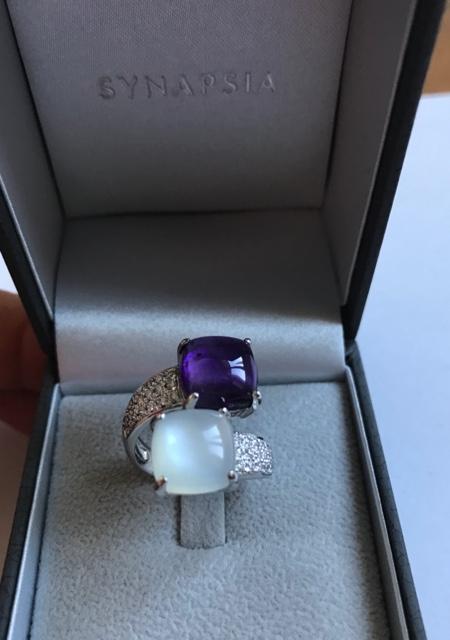
MEANING and history
Fascinated by the moon, our ancestors believed the silvery to bluish sheen of this stone was created by moonbeams. It is sacred in India, and the Romans believed its appearance changed with the phases of the moon. In India, placing a moonstone in the mouth on a full-moon night was thought to reveal the future of couples. It is often associated with love. In 1970, after the moon landing, Florida made it its official state gem.
OriginS
The main deposit is in Sri Lanka; it is also found in India, Madagascar, Tanzania, Brazil, Germany and Norway, in plutonic and metamorphic rocks.
Hardness & Care
A feldspar of the silicate group, a variety of orthoclase, moonstone has a hardness of 6 to 6.5 on the Mohs scale. Avoid ultrasonic cleaning; rinse under running water.
VIRTUES
Traditionally, a stone of balance, it is said to bring calm and peace in stressful times. A symbol of femininity and a protective stone, it is also linked to openness and tolerance, and is believed to foster harmony, especially between partners.
The ideal metal
Silver and white gold, with their soft, cool tones, perfectly echo the stone’s lunar character and reveal its full beauty.